
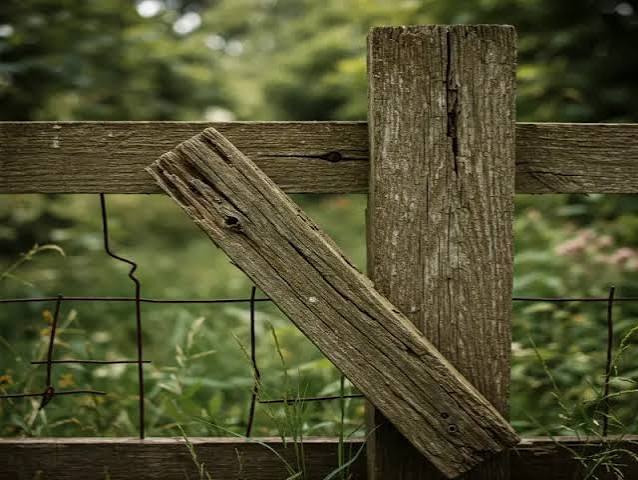
There comes a point when another coat of fence treatment is doing little more than colouring the problem. I regularly see old timber boundaries that have been carefully stained every couple of years while the posts underneath are quietly deteriorating. Once decay has taken hold around the ground line, painting the visible timber won’t fix it. At that stage, sensible fence repairs are usually a better use of money than another weekend spent with a brush.
That doesn’t mean treating timber fencing is pointless.
Far from it.
The mistake is confusing maintenance with repair.
Wood treatment can help protect sound timber. It cannot restore structural strength to timber that has already rotted.
The bit you paint is often the bit I’m least worried about
Stand in front of an ageing timber fence and most of what you can see may look reasonably healthy.
The panels have weathered. Perhaps the colour has faded. There might be a few small splits and knots showing.
None of that necessarily concerns me.
I want to know what is happening at the bottom of the posts.
Timber posts often deteriorate around ground level before serious decay becomes obvious further up. It is an unforgiving part of the structure. The timber is exposed to moisture, soil, changing weather conditions and repeated cycles of wetting and drying.
The visible upper section might still feel hard and substantial.
Then you put some pressure against the post and discover movement at the base.
I’ve encountered posts that looked surprisingly good until they were removed. Once out of the ground, the deterioration around the lower section told a completely different story.
That is why looking at colour alone tells you very little about the structural condition of a fence.
Wood treatment has a job, but know what that job is
Fence treatments are useful.
Applied to suitable timber and maintained properly, they can help reduce moisture penetration and weathering. Some products also improve appearance, which is reason enough to use them if you want the fence looking smart.
But treatment is preventative maintenance.
Think about the difference between maintaining a car and repairing a broken component. Changing the oil regularly is sensible maintenance. Changing the oil doesn’t repair a snapped suspension spring.
The same principle applies here.
If a timber post is sound, looking after it makes sense.
If you can push a screwdriver into soft, degraded wood around its base, covering it with another layer of brown treatment doesn’t make it structurally sound again.
It just gives you brown rot.
Pressure treatment isn’t immortality
There is sometimes confusion around pressure-treated timber too.
Pressure treatment significantly improves timber’s resistance to decay and biological attack. It is one of the reasons properly specified treated timber is widely used for external construction.
But “treated” and “incapable of deteriorating” are not the same thing.
Timber species, treatment class, installation, drainage, exposure and maintenance all affect how something performs over time.
So does workmanship.
A decent treated post installed correctly can give long service. The same piece of timber installed badly can have a much harder life.
If water is constantly collecting around a post, drainage is poor or the installation creates conditions that keep parts of the timber persistently wet, treatment isn’t a magic shield.
The structure still needs to be designed and installed sensibly.
Find out whether it is surface weathering or actual decay
This is where homeowners sometimes spend money unnecessarily.
Weathered timber isn’t automatically rotten timber.
A fence that has turned silver-grey may still be structurally excellent. Surface checking and small cracks can also occur naturally as external timber experiences changes in moisture.
I’d take an ugly but structurally sound fence over a freshly stained unstable one every time.
If you’re inspecting an older fence, concentrate on condition rather than colour.
Press the posts gently and look for movement at ground level. Examine accessible timber near the base. Look for areas that are unusually soft, crumbly or visibly deteriorated.
Pay attention to connections too.
A post might be sound while rails or boards have failed around their fixings. In that situation, the repair can be very different.
You are trying to establish what has actually deteriorated.
Painting everything because it looks old skips that question completely.
A leaning fence isn’t going to straighten itself after staining
This sounds obvious, yet cosmetic work is frequently carried out on fencing that already has structural problems.
If a post is leaning, find out why.
Perhaps the timber has failed underground.
Perhaps the concrete footing has moved.
Perhaps the original post hole wasn’t substantial enough.
Perhaps nearby roots have affected it.
Perhaps the fence is in an exposed position and years of wind loading have gradually shifted the structure.
Whatever the reason, wood stain isn’t on that list.
Before spending money improving the appearance of an old boundary, stand at one end and look along the fence line.
It is a useful perspective.
Individual posts that have started leaning become much easier to identify. So do sections that have bowed or shifted relative to the rest.
If everything is sound and straight, carry on with the maintenance.
If several posts are moving, put the brush down.
Don’t automatically replace the whole fence either
There is an opposite mistake.
One rotten post doesn’t necessarily mean you need 20 metres of new fencing.
Timber components don’t always deteriorate at exactly the same rate. One post may have experienced poorer drainage. Vegetation may have kept one area wetter. A particular section might take more wind.
If the rest of the structure is sound, repairing the affected section can make perfect sense.
This is especially true with well-built traditional fencing where rails, boards and the majority of the posts still have plenty of usable life.
Throwing all of that material away because one component has failed isn’t particularly clever.
The decision changes when deterioration is widespread.
If several posts of the same age are showing similar decay, repairing them individually over the next couple of years can become expensive and disruptive.
There isn’t a universal rule.
Inspect first.
Then decide.
Concrete posts change the maintenance equation
One reason some homeowners choose concrete posts and gravel boards is to remove timber from some of the areas most vulnerable to deterioration.
There are trade-offs.
Concrete components are heavier. Installation needs to account for that. They also create a different appearance, which some people prefer and others don’t.
But combining concrete posts and gravel boards with replaceable timber panels can make future maintenance straightforward.
If a timber panel eventually reaches the end of its life, it can usually be replaced without disturbing the main supporting structure, assuming the posts remain sound.
Traditional timber posts still have plenty of advantages. They can create a softer appearance and work extremely well when properly specified and installed.
The point isn’t that one system is universally superior.
It is that different types of garden fencing fail and age in different ways. Maintenance should reflect the structure you actually have rather than following a generic routine every spring.
Be careful with timber touching soil
Whenever I look at a timber boundary, I’m interested in where wood is sitting in prolonged contact with wet soil or vegetation.
Fence boards buried into the ground are an obvious example.
So are rails concealed behind dense planting and timber gravel boards sitting in persistently damp conditions.
Moisture needs somewhere to go.
If you have shrubs growing hard against the fence, give the boundary enough space to dry after rain. Clear accumulated leaves and soil from places where they are trapping moisture against timber.
This is not glamorous garden maintenance.
Nobody is going to admire the photograph of the 50mm gap you cleared between a shrub and a fence post.
It can still be more useful than another coat of expensive treatment.
Don’t seal moisture into timber
Timing matters when applying treatment.
Putting certain coatings onto timber that is still very wet can cause problems because you’re trying to protect a material before it has had a reasonable opportunity to dry.
Read the instructions for the particular product rather than assuming all treatments behave identically.
The same applies to preparation.
Painting over loose material, algae, dirt and deteriorated previous coatings rarely produces a good result. If you’re going to maintain fencing, doing the preparation properly is part of the job.
That may mean cleaning it, allowing it to dry and dealing with small defects before applying anything.
Maintenance isn’t simply buying the largest tin in the DIY shop and covering everything brown.
Composite doesn’t eliminate the need for inspection
The attraction of composite fencing is understandable for people who don’t want the maintenance associated with traditional timber boards.
You don’t have the same routine of staining or painting the fencing itself.
That doesn’t mean you should never inspect it.
The panels are only part of the system.
Posts, footings, fixings, gates and surrounding ground still matter. Wind still puts force through a fence. Ground can still move. A badly installed composite system doesn’t become well installed simply because the boards require less maintenance.
This is something worth remembering whenever a material is sold as “low maintenance”.
Low maintenance does not mean no maintenance, and it certainly doesn’t mean no structural inspection.
Spend money on the cause, not the colour
If a fence is structurally sound but looks tired, painting or treating it can be one of the cheapest ways to improve a garden.
I have no argument with that.
A well-maintained timber fence can look excellent, and preventative care is far preferable to ignoring timber until deterioration becomes serious.
Just perform the jobs in the right order.
Check the posts.
Check the rails.
Look along the boundary.
Open the gate.
Inspect the timber around ground level.
Clear vegetation where necessary.
Work out whether anything is actually moving.
Only then worry about the colour.
If everything underneath is sound, get the brush out.
If the post moves every time you touch it, save the paint. The fence is asking for a repair, not a makeover.
About the Author